The GP appointment
The hairline that moves back evenly, and the eyebrows that go with it
I write about this condition with some care, because it is uncommon and I do not want to frighten the many women whose hairline is receding for the ordinary hormonal reasons. But it is being diagnosed more every year, it affects women in exactly the age group this site is written for, and the difference between finding it at year one and year five is permanent.
What it is
Frontal fibrosing alopecia (FFA) is an inflammatory, scarring form of hair loss in which the immune system attacks the follicles along the front hairline and destroys them, replacing them with scar tissue. Destroyed follicles do not come back. It was first described in the 1990s and has become steadily more common since, for reasons that are not fully understood; it is seen mostly in women between their forties and sixties, but increasingly in the late thirties.
How it differs from ordinary temple thinning
Ordinary hormonal thinning at the temples leaves the follicles in place, producing finer hairs; the skin looks like normal scalp; and it is patchy and uneven, worse at the corners. FFA is different in four ways worth looking for.
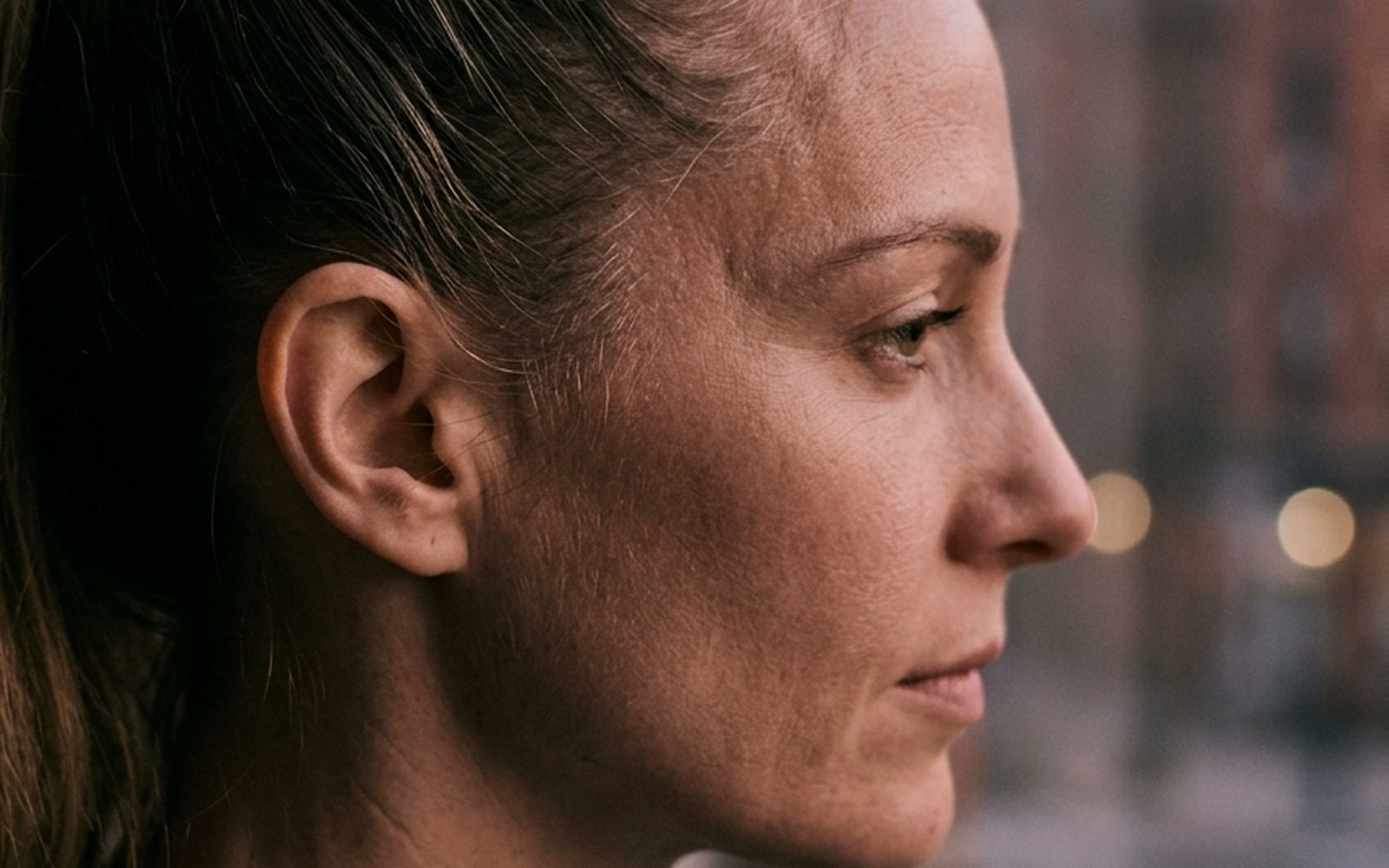
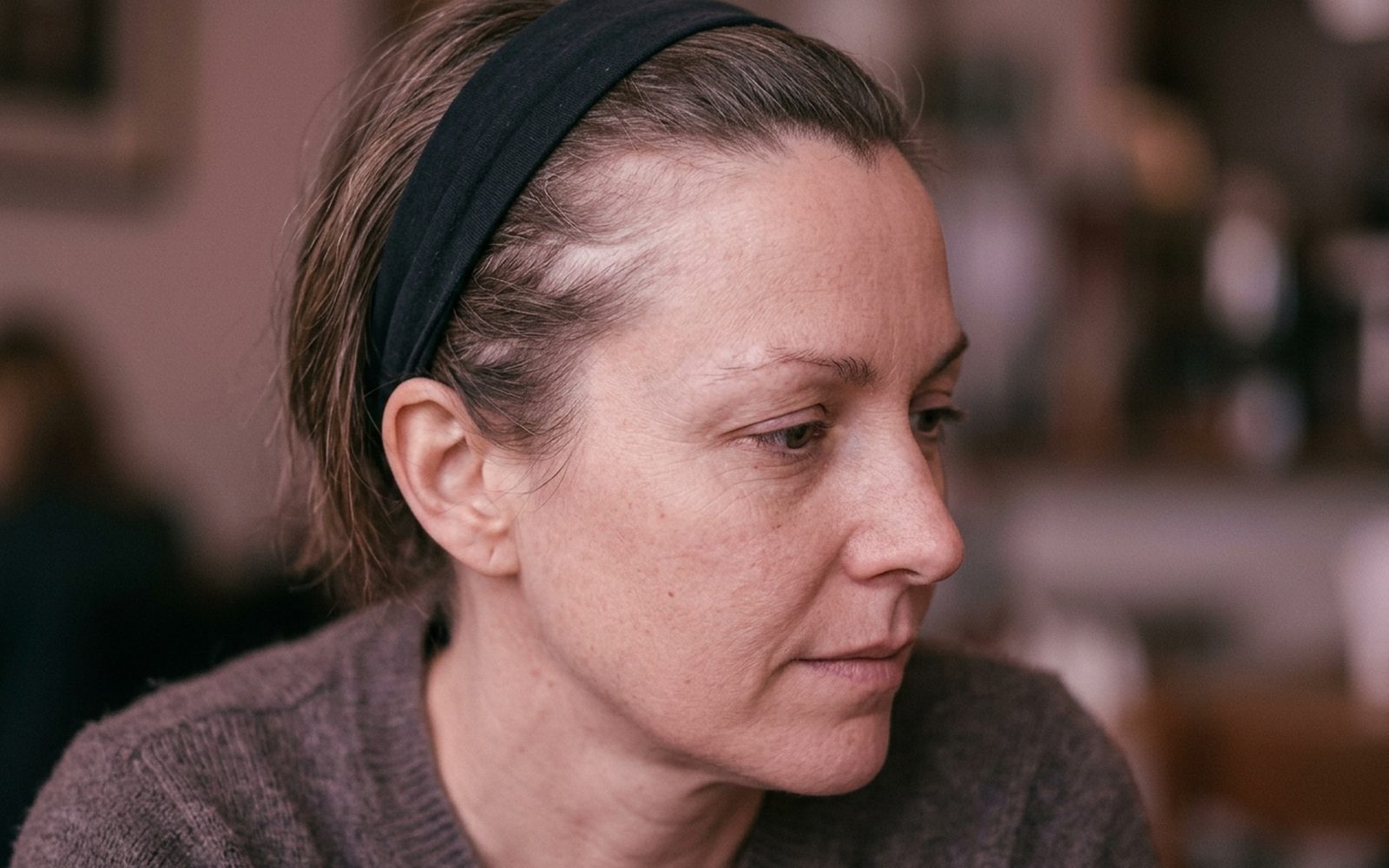
The hairline moves back as a band. Rather than the corners receding, the whole front edge shifts backwards by a few millimetres to a few centimetres, often fairly evenly, sometimes extending round to the sides above the ears.
Not sure which one is you?
Take the two-minute hair quiz
Twelve quick questions. We tell you what we think is going on, what to do about it, and we say so if it is something we cannot help with.
Start the quiz →The skin left behind looks different. Pale, smooth and slightly shiny, without the small pores of the follicle openings, and often a slightly different colour from the forehead below it. You can sometimes see where the old hairline was because the skin above it is more sun-tanned.
The eyebrows go. Loss of the outer part of the eyebrows, or of the whole brow, happens in most women with FFA and often before the hairline is noticed. Eyebrows thinning in your forties with no other reason is the single most useful early sign.
Lone hairs. A few isolated hairs left standing in front of the new hairline, in the bare zone, are characteristic.
Other signs: small skin-coloured bumps on the face or temples, itching or tenderness along the hairline, loss of body hair on the arms and legs, and sometimes a pattern of thinning at the sideburns.
Why it matters to catch it early
Because it scars, treatment cannot regrow what is lost; it can only halt the advance. A woman who starts treatment when the hairline has moved a centimetre keeps her hairline a centimetre back. A woman who was told for four years that it was her age loses four years of hairline she cannot recover. That is the whole point of this article.
What to do
If you recognise two or more of the signs above — particularly eyebrow loss with a smooth, even recession — ask your GP for a dermatology referral, and use the words “possible frontal fibrosing alopecia”. Diagnosis is by examination, sometimes a small scalp biopsy. Treatment is with anti-inflammatory and anti-androgen medications that a dermatologist prescribes, and it does work at stopping progression in most women.
Ready to read your own pattern?
Take the two-minute hair quiz
Twelve questions. We tell you what we think is going on for you, and we say so if it is something a GP should see first.
Start the quiz →