Habits
Colouring thinning hair: what to ask for, what to avoid, and why the roots matter most

Most of the mums I see colour their hair, and most of them have quietly wondered whether the colour is part of the problem. The honest answer is: it depends on the colour. Done one way it is the kindest thing you can do for a thinning parting. Done another way it is doing a slow, steady amount of damage that shows up as breakage and gets blamed on the follicle.
First, the reassurance
Colour does not cause hair loss from the follicle. The dye sits on and inside the fibre; it does not reach the bulb a few millimetres below the skin, and it does not switch off growth. If your hair is thinning at the temples or the parting, the colour did not do that. What colour can do is weaken the fibre you already have, so that hairs snap before they reach full length — and on hair that is already fine from miniaturisation, that shows quickly.
The three things that actually damage the fibre
Lift. Anything that lightens the hair has to open the cuticle and remove pigment, and the more shades of lift, the more structural protein is lost. Going from mid-brown to blonde is where most of the damage in the world lives. A tint that is the same depth or darker than your natural shade barely touches the structure.
Overlap. When a colourist takes the product through the lengths every six weeks rather than just the regrowth, the mid-lengths get processed ten or twelve times a year. This is the single most common cause of the “my hair used to be thick and now it is thin and crispy” complaint, and it is entirely avoidable.
Not sure which one is you?
Take the two-minute hair quiz
Twelve quick questions. We tell you what we think is going on, what to do about it, and we say so if it is something we cannot help with.
Start the quiz →Heat afterwards. Freshly coloured hair has a raised cuticle for a few days. Straightening it hot the same evening is where a lot of the breakage begins.
What to ask for if you are thinning
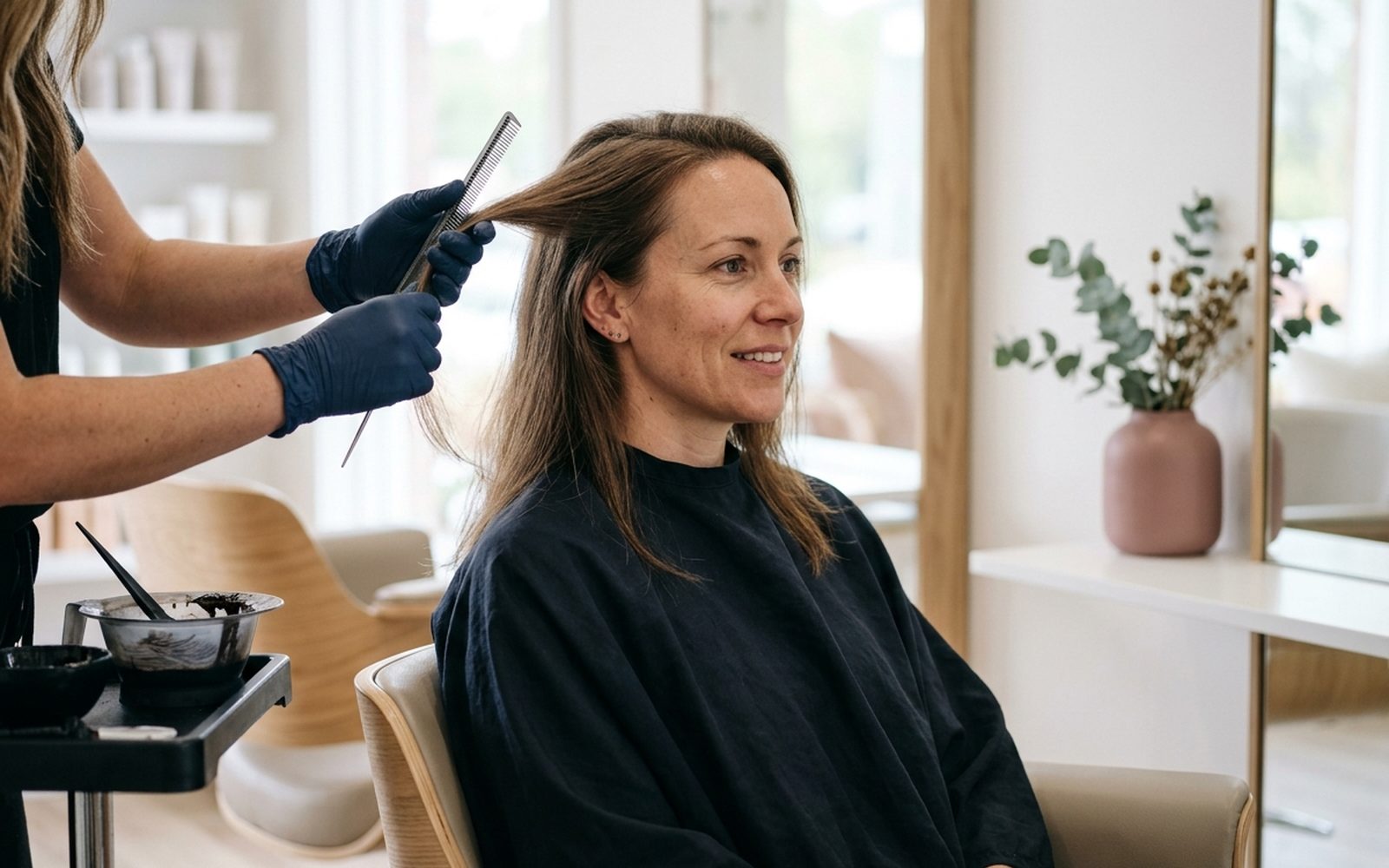
Ask for a root-only application. Say it in those words. A good colourist will do this by default for a permanent tint; a busy one may not unless asked. The lengths should only be refreshed with a gloss or demi-permanent that does not lift.
Stay within two shades of your natural depth. The closer the target colour is to what grows out, the less lift is needed and the softer the regrowth line is — which, if your parting is widening, matters more than you think. A hard line between dark regrowth and light lengths draws the eye to exactly the place you do not want it.
Ask about a root shadow or “root smudge”. This is a slightly deeper tone at the root that blends into the lengths. It does two useful things: it hides regrowth for longer, and it darkens the scalp-adjacent hair so that any visible scalp reads as shadow rather than skin. For a widening parting it is the most effective trick a colourist has.
Ask for demi-permanent, not permanent, if you are covering a little grey. Demi-permanents deposit without lifting and fade gracefully. They will not cover a head of resistant white, but for scattered grey at the temples they are far gentler.
Highlights and balayage
Face-framing highlights are the one place where lightening is worth it for a thinning hairline, because lighter hair at the temples reduces the contrast between hair and skin and makes sparse corners far less obvious. The trick is to keep them fine and few, and to have them painted on rather than foiled to the root. Balayage — hand-painted through the mid-lengths with the root left natural — is generally the friendliest lightening technique for fine hair because it avoids both the root and the overlap problem.
The box dye question
Home colour is not inherently worse. The two problems are that box dyes are formulated to work on everybody, so they tend to be stronger than a fine head of hair needs, and that almost everyone applies them root to tip. If you colour at home, buy a shade at or darker than your natural depth, apply to the regrowth only, and pull through the lengths for the last five minutes at most.
What colour cannot do
It cannot make the follicles produce thicker hair. A good root shadow will make a thin parting look better on the day and for the weeks that follow, and there is nothing wrong with that; but it is cover, and if the follicles beneath it are miniaturising, the parting will keep widening under the colour. That is a separate problem with a separate answer, which is what the pattern article and the product article deal with.
Ready to read your own pattern?
Take the two-minute hair quiz
Twelve questions. We tell you what we think is going on for you, and we say so if it is something a GP should see first.
Start the quiz →