Reading the signs
The school-run photograph: why you look thinner in photos than in the mirror

The first-day-of-school photograph is, for a great many mums, the moment. You crouch beside a child in an oversized uniform, someone snaps it from standing height, and there in the corner of the picture is the top of your head, and it is not what you thought it looked like.
Why the photo is unkind
Four things are working against you. The angle. Anyone standing while you crouch is photographing your parting and crown from above — the two places thinning shows first and the two places you never see. The light. Overhead daylight comes straight down onto the scalp and lights it, so any scalp between hairs reads as a pale line. Bathroom light comes from the front and the sides and fills those gaps. The compression. A phone camera at a distance flattens the hair against the head and loses the fine flyaway hairs that give an impression of volume close up. The arrangement. You did not do your hair for this photo the way you do it for the mirror.
Why the mirror is kind
You look at yourself from the front, at eye level, having arranged the parting and pulled a few hairs across. The light is at your level. Your brain, which has been looking at this face for forty years, edits what it sees toward what it expects. Every one of these makes hair look fuller than a photograph will.
So which is true?
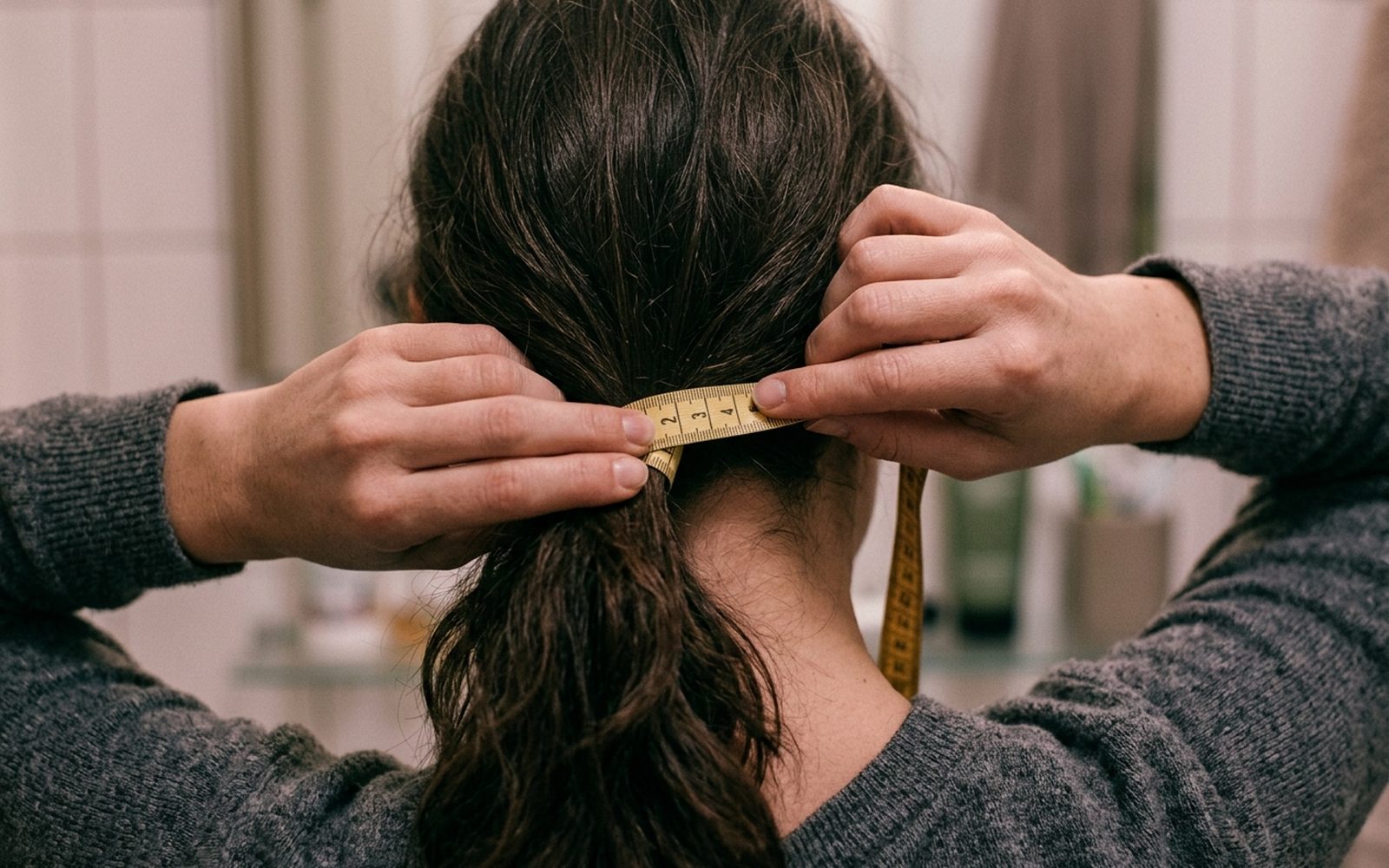
Neither, quite. The mirror understates; the school-gate photo overstates, because the top-down overhead-light angle is the harshest one there is. The truth is between them, and it is better measured than looked at — which is what the ponytail test and the photo protocol are for. But the photograph is not lying about the direction: if your crown looks thinner in this year’s school photo than in the one from three years ago, taken at the same gate by the same person, it is thinner.
Not sure which one is you?
Take the two-minute hair quiz
Twelve quick questions. We tell you what we think is going on, what to do about it, and we say so if it is something we cannot help with.
Start the quiz →What other people actually see
Most people are shorter than the school-gate camera and see you at eye level in ordinary light, which is closer to the mirror. Taller people, people on stairs above you, and anyone in a car when you bend to the window see the top of your head. Children on shoulders and hairdressers see it constantly. None of them are looking as hard as you are.
Using the photo well
Rather than deleting it, keep it. Find the same photo from previous years and put them side by side; it is one of the few genuinely comparable images you have, because it is the same place, the same season, roughly the same light and the same angle, every year. If the change over three Septembers is clear, you have your answer and a baseline. If it is not, you can stop reading your parting in every reflective surface.
Ready to read your own pattern?
Take the two-minute hair quiz
Twelve questions. We tell you what we think is going on for you, and we say so if it is something a GP should see first.
Start the quiz →